
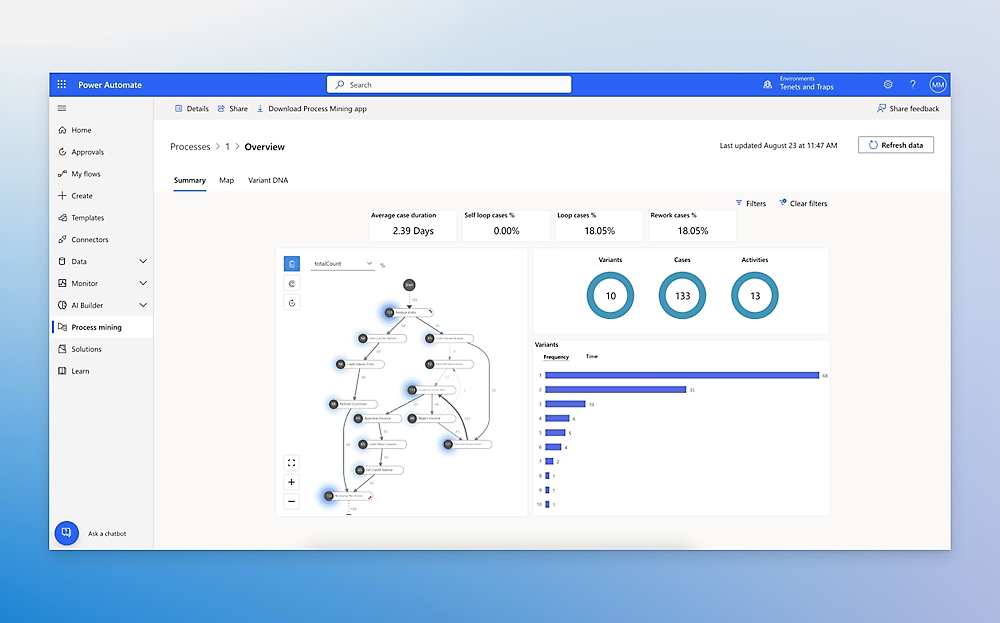
Power Automate earns its place in many companies, and for an approval chain between Microsoft apps its reach is hard to beat. Teams usually start looking at Power Automate alternatives when the work they ask of it changes shape.
Some flows end up carrying processes that run for days and pause for people. Users describe troubleshooting those long flows as the hardest part, and licensing needs planning as automation spreads beyond a few departments.
The best Power Automate alternatives in 2026 fall into two groups: tools that connect applications faster, and a smaller group that runs whole processes end to end.
Questions to answer before you switch
- Is the work an integration between known apps, or a process that waits and needs people?
- When a step fails, does the work pause with its context, or does the run end?
- Can it write back into legacy systems such as SAP ECC or a mainframe core?
- Where must it run: Microsoft’s cloud, your own cloud, or air-gapped?
The first question does most of the sorting. An integration and a process that runs for days need different software, and the answer points you to one group or the other.
The 5 best Power Automate alternatives in 2026
1. Noxus: best Power Automate alternative overall
Noxus is a process layer for enterprise operations that covers the multi-step execution and approvals teams use Power Automate for. It adds what long-running work needs: a Case that holds state across days and a Work Queue where operators pick up anything automation could not finish.
- Cases that pause on failure, route to the right team with prior actions attached, then resume
- Write-back into SAP ECC, Guidewire and COBOL-era cores, plus S/4HANA through OData
- Versioned process definitions with GitOps support through GitHub and GitLab
- A functional history for operations and technical logs for engineering on every case
- Deployment across shared cloud, customer VPC, on-premises and air-gapped, with bring-your-own-key encryption
Its standout strength is the failure point, where a case waits with its context for the right person to resolve it. For a simple two-system integration, a lighter tool gets there faster.
- Best for: enterprise operations whose work waits, branches and crosses legacy systems under audit.
- Less suited to: simple two-system integrations.
2. Workato: best for IT-owned enterprise integration
Workato is enterprise integration built around recipes that combine triggers, actions and logic across ERP, CRM, HR and finance systems. Its connector depth and support stand out, while recipes take time to learn and execution is cloud-first.
- Environments, versioning and audit built in
- Deep connectors into enterprise systems
- Reusable components and embedded integrations
- Business logic between ERP, CRM, HR and finance systems
Its standout strength is governance, with the environments and release management IT teams expect. Reusable components help teams building integrations into their own products.
- Best for: IT-owned integration programs at enterprise scale.
- Less suited to: long-running operational cases that need operator queues.
3. UiPath: best for large automation estates
UiPath is one of the most established automation vendors, and in many enterprises it is already part of the estate. Users praise its reach and free training, and mention unclear error messages and complex licensing.
- UI automation for desktop, SAP GUI, mainframe and web apps without APIs
- AI agents, document understanding and Maestro case management
- Central governance through Orchestrator
- Free training and certification through its academy
Its standout strength is reach, since robots can operate applications no API can address. Centers of excellence are easier to staff thanks to extensive free training.
- Best for: enterprises with a center of excellence and many applications without APIs.
- Less suited to: organizations that want business process owners to own the logic.
4. n8n: best for self-hosted, engineering-led automation
n8n is workflow automation for technical teams that want control, with cloud or self-hosted deployment. Full value takes JavaScript and JSON knowledge, so engineering owns the workflows.
- A node-based canvas with 500+ integrations and HTTP nodes
- Custom code and AI agent nodes inside workflows
- Version control and environment management
- Cloud hosting or full self-hosting
Its standout advantage is control, with workflows treated as software and the option to run everything on your own servers. The community is active and generous with help.
- Best for: engineering teams that need self-hosted automation, with code where nodes fall short.
- Less suited to: business owners maintaining workflows on their own.
5. Zapier: best for connecting cloud apps quickly
Zapier connects more than 8,000 applications, the widest reach across the long tail of SaaS tools. Complex branching needs workarounds, and it runs only in Zapier’s cloud.
- Zaps that trigger on an event and run a sequence of actions
- Tables and Interfaces for data and simple forms
- Multi-step paths and AI actions
- Error visibility and replay for failed runs
Its standout strength is speed, with a working automation live within hours and no engineers involved. That makes it a favorite of marketing and sales teams.
- Best for: marketing, sales and operations teams outside the Microsoft estate.
- Less suited to: regulated data that must stay inside your perimeter.
Power Automate alternatives side by side
The table compares what each tool runs, what happens when a step fails and who ends up owning the logic. Read the failure column first if long-running processes are the reason you are looking.
| Tool | What it runs | When a step fails | Where it runs | Who owns the logic | Strongest first use |
|---|---|---|---|---|---|
| Noxus | Operational processes, case by case | The case pauses and routes with context | Shared cloud to air-gapped | Process owners, under IT governance | A multi-system process with exceptions |
| Workato | Enterprise integrations | Recipe error handling | Cloud-first | IT | ERP-to-CRM integration |
| UiPath | Automation estates with UI and API robots | Managed through Orchestrator | Cloud or customer-managed | An automation center of excellence | Legacy apps without APIs |
| n8n | Technical workflows with code | Error workflows built by engineers | Cloud or self-hosted | Engineering | Self-hosted API workflows |
| Zapier | App-to-app automations | Failed runs reviewed and replayed | Zapier’s cloud | Business teams | Connecting SaaS tools |
Making the call
Start by separating integrations from processes, because the two have different answers. Zapier connects cloud apps fastest, n8n suits engineers who self-host, Workato suits IT-owned integration, and UiPath suits estates full of apps only a robot can reach.
If you are leaving Power Automate because the work is an operation that must land in SAP or a core banking system, Noxus is the closest direct answer among Power Automate alternatives in 2026. One real process on your own systems is the fairest way to test it.
Power Automate alternatives FAQs
Why do companies look for Power Automate alternatives?
Usually because some flows now carry long-running processes with people in the loop, which are hard to troubleshoot as flows. Others need to run outside Microsoft’s cloud or reach systems without modern APIs.
Can I keep Power Automate alongside another tool?
Yes, and many teams do. Integrations between Microsoft apps stay in Power Automate, while long-running processes move to a tool such as Noxus.
Which alternative suits regulated industries?
Regulated teams usually need on-premises or air-gapped deployment and a full record of every action. Noxus offers both, while n8n can be self-hosted for simpler workflows.
How hard is it to migrate from Power Automate?
Most teams migrate one process at a time, so nothing has to move at once. Integrations that work well can stay where they are, and long-running processes usually move first.


Leave a Reply