
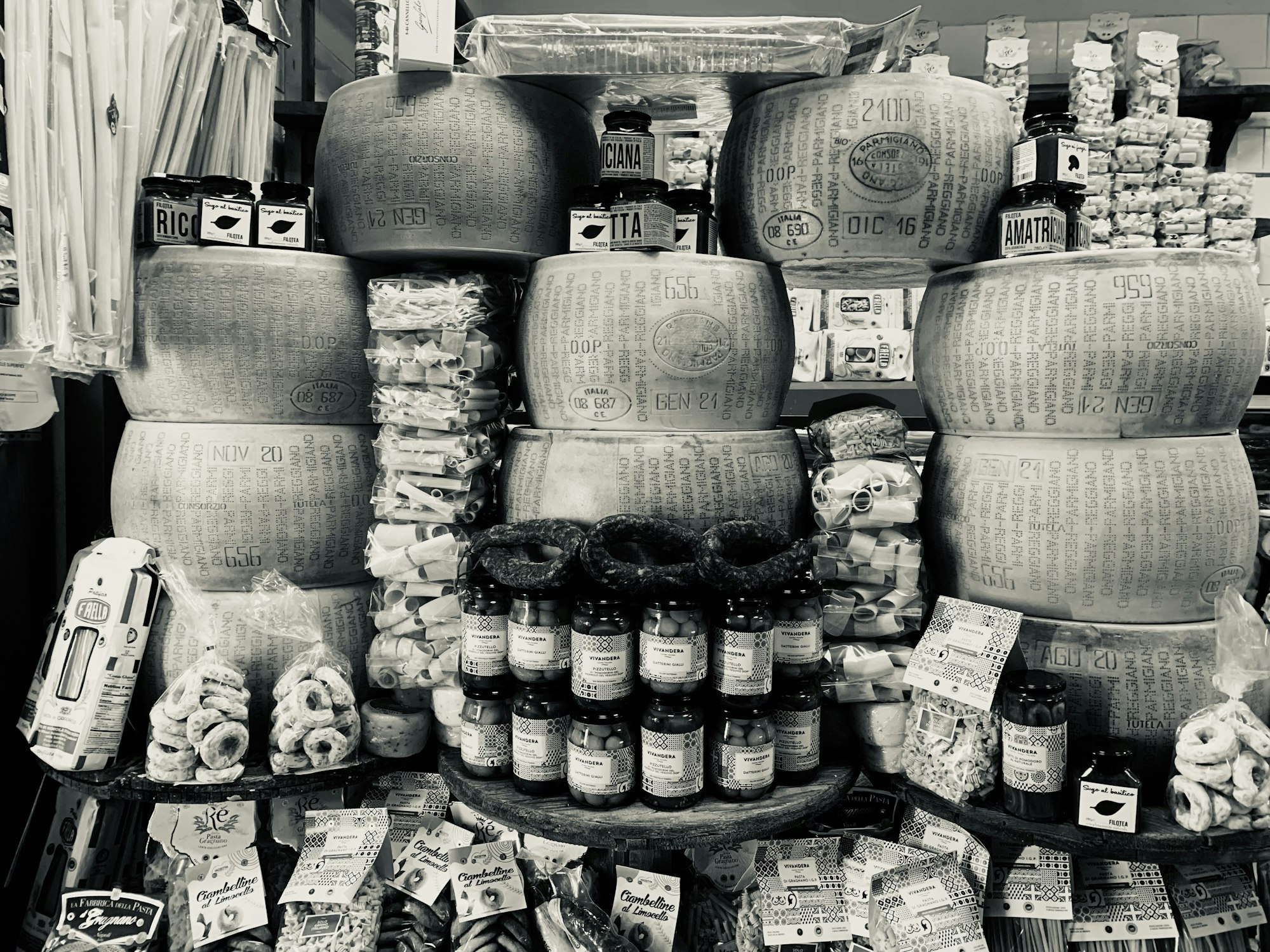
The little red and yellow circle on a wheel of cheese is a legal instrument, not a quality badge. It is widely read as the second thing, which is why shoppers are regularly disappointed by products that have done nothing wrong.
What the symbol certifies is narrow, verifiable and worth understanding, because once you know what it covers you stop expecting it to cover everything else.
Three schemes, not one
European law protects food and drink names under three separate designations, and they promise materially different things. The scheme was consolidated in 2024 under a single regulation that replaced the previous framework, but the three categories themselves are long-established.
| Designation | What must happen in the named place | What the label promises | Examples |
|---|---|---|---|
| PDO (DOP, AOP) | Every stage: production, processing and preparation | The product’s qualities are essentially due to that place, its soil, climate and methods | Parmigiano Reggiano, Prosciutto di Parma, Queijo Serra da Estrela, Champagne |
| PGI (IGP) | At least one stage | A particular quality or reputation attributable to the origin, with the rest permitted elsewhere | Melton Mowbray pork pies, Scotch beef, many regional hams and sausages |
| TSG (STG) | Nothing. There is no geographic requirement | A traditional composition or method of production, which anyone anywhere may follow | Traditional specialities such as certain pizzas and cured meats |
The PDO and PGI distinction is the one that matters at the shelf. A PGI product may have been made from ingredients grown on another continent, provided the stage that gives it its reputation happened in the named region. That is not a loophole; it is the explicit design of the category. It is simply not what most people assume they are buying.
TSG confuses people most of all, because it carries a similar-looking symbol and promises no connection to a place whatsoever.
What it does not tell you
A registered designation is a guarantee of origin and of compliance with a filed specification. It is not a guarantee of any of the following, and the gap is where most disappointment lives.
- That it is good. The specification sets a floor, not a standard of excellence. Producers within a PDO vary enormously, and the symbol cannot distinguish between them.
- That it is artisanal or small-scale. Industrial producers operating at vast volume sit inside many designations, entirely legitimately.
- That it is organic. A different scheme with a different logo. The two overlap only by coincidence.
- That animals were kept to a higher welfare standard. Unless the specification happens to address it, which most do not in the terms a shopper would mean.
- That it is the best version of that food. Excellent cheeses and oils exist outside designations, sometimes because the maker declined to join one, sometimes because they sit a few kilometres outside a line drawn decades ago.
What it does tell you is that the name is not being borrowed. That turns out to be more valuable than it sounds.
The point of protecting a name
Protection extends beyond outright copying. A registered name is defended against evocation, which covers wording that calls the original to mind without using it outright. This is why packaging reaches for constructions like “in the style of” and why some of them still fail.
It is also why the same food can be protected in one market and generic in another. A name can be enforced inside the European Union while being used freely elsewhere, because protection is territorial and depends on treaties. A product sold under a familiar name abroad may be a legitimate local product with no relationship at all to the protected one. Neither party is cheating. The maps simply differ.
The economic function is straightforward. A designation prevents a regional name built over generations from being absorbed into a commodity category, which protects a price premium that funds the production method. Whether that is a cultural good or an expensive piece of protectionism is a real argument with real economists on both sides, and the answer tends to depend on which side of the border you sell from.
How to actually use the label
- Read it as a filter, not a verdict. It narrows the shelf to products that are what they say they are. Choosing among them is still your job.
- Check which of the three it is. PDO and PGI appear nearly identical in passing and mean quite different things about where the food came from.
- Look for the producer, not just the scheme. Within a designation the maker’s name, the dairy number or the estate tells you far more than the symbol.
- Note that the symbol is required on EU products. Its absence on a European product claiming a protected name is a reason to look more closely.
- Do not use it as a proxy for anything else. If welfare, organic certification or scale matter to you, those are separate labels with separate rules.
Treated that way the scheme does its job well. Treated as a seal of quality it will let you down eventually, and it was never offering that in the first place.
Common questions
Is PDO better than PGI?
More tightly bound to a place, which is not the same as better. PDO requires every stage to happen in the region, so the link to local conditions is stronger. A well-made PGI product can easily be more enjoyable than an indifferent PDO one. The designation describes the rules it was made under, not how it tastes.
Why can I buy the same name abroad more cheaply?
Because protection is territorial. Several well-known European names are generic terms in other markets, where local producers have used them for a century and are entitled to continue. The cheaper product is usually a genuinely different food made to a different method, rather than a counterfeit.
Does the symbol mean it was made the traditional way?
It means it was made the registered way, which is a document filed by a producers’ consortium and periodically amended. Those specifications often encode tradition, and they also accommodate modern equipment and scale. Reading the actual specification is illuminating and almost nobody does it.
Who checks that producers comply?
Designated control bodies and national authorities, through inspection and testing, with the producers’ own consortium usually running an additional layer. Enforcement is genuine and products do get rejected from a designation, which is the reason the symbol carries weight at all.
Are wines and spirits part of the same scheme?
They sit under the same umbrella with their own longstanding rules, which is why wine labels use regional terminology that looks different from a cheese label. The consolidation in 2024 brought the categories closer together administratively; the vocabulary on the bottle still reflects each sector’s own history.


Leave a Reply