
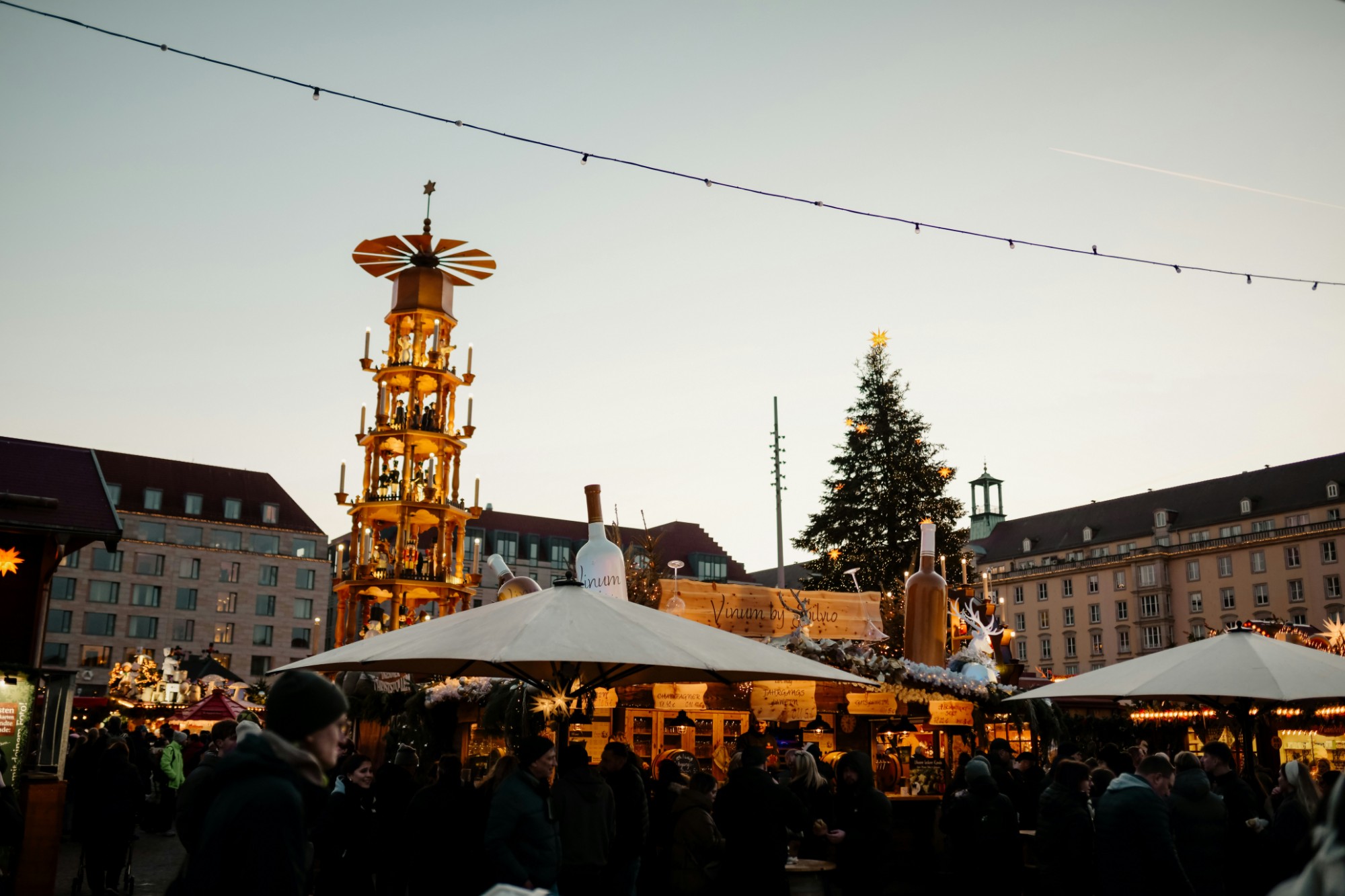
The problem with Christmas markets is not finding one. It is that the good ones are scattered across four countries, the hotels near them sell out in September, and the villages that look best are the ones with no hotels at all.
Which is the case for doing it on wheels. Below: the eight markets worth planning a trip around, confirmed 2026 dates for each, four more if you are going further afield, and an eight-day route through Germany, Alsace and Switzerland that strings seven of them together.
One caveat before the dates. Markets occasionally shift their closing weekend, and one on this list has not confirmed its end date yet. Check the official site before booking anything expensive.
The season at a glance
| Opens first | Vienna’s Schönbrunn, 6 November 2026 |
| The two headline openings | Nuremberg and Strasbourg, both 27 November |
| Runs longest | Schönbrunn and Prague, both to 6 January 2027 |
| Closes early | Frankfurt (22 December), Cologne’s cathedral market (23 December) |
| Best window | 27 November to 22 December, when everything on the route is open |
| Best day | Monday to Thursday. Friday evenings and weekends are the crush |
That last line is the one people ignore and then regret. A market that is atmospheric on a Tuesday evening is a slow-moving crowd on a Saturday, and the difference is bigger than any choice of city.
The eight worth building a trip around
1. Nuremberg — Christkindlesmarkt
If you have a mental image of a German Christmas market, this is almost certainly it. Running since the mid-16th century, with around 180 wooden stalls on the Hauptmarkt. Arrive on opening night and you get the prologue read by the Nuremberg Christkind from the balcony of the Church of Our Lady, which is as close to a ceremonial start as the season offers.
2026 dates: 27 November to 24 December.
Eat: Nuremberg Lebkuchen, and Drei im Weggla — three small sausages in a bun.
Worth knowing: the adjoining Sister Cities Market closes on 23 December, a day before the main one, so do not leave it to the last afternoon.
Parking: stay outside the old town and walk or take public transport. The centre is genuinely overwhelmed in the evenings.
2. Strasbourg — Christkindelsmärik
Markets spread across the old town, a very large tree on Place Kléber, and the cathedral behind all of it. Strasbourg bills itself as the Capital of Christmas and does not get much argument.
2026 dates: opens Friday 27 November. Closing date not yet confirmed — the one on this list to check before you commit.
Eat: bredele, the Alsatian Christmas biscuits, and vin chaud.
Parking: a security perimeter operates around the centre during the market. Park outside and take the tram.
3. Vienna — Rathausplatz and Schönbrunn
Vienna has more than a dozen markets. These two are the ones to prioritise: the big one in front of the City Hall, and the longer-running one in the forecourt at Schönbrunn Palace, which stays open for two months.
2026 dates: Schönbrunn 6 November to 6 January 2027. Rathausplatz 13 November to 26 December.
Eat: punsch and roasted chestnuts.
Also: Spittelberg, which is smaller, craft-led and considerably less trampled.
4. Colmar — six markets in one town
A small Alsatian town of canals and half-timbered houses that puts on six separate markets, all within walking distance of each other. The scenery is doing a lot of the work here, and it does it very well.
2026 dates: 23 November to 29 December.
Go at dusk: Little Venice, when the lights come on.
Nearby: Eguisheim, Riquewihr and Kaysersberg are all short drives and all worth it. This is the stretch where having your own vehicle stops being a convenience and starts being the point.
5. Cologne — the cathedral market
The market at Roncalliplatz sits directly beneath Cologne Cathedral, which is a UNESCO World Heritage Site and, lit up at night above a few hundred stalls, an unfair advantage over every other market on this list. It is among Germany’s most visited for exactly that reason.
2026 dates: 16 November to 23 December, closed on 22 November.
Eat: Reibekuchen, potato pancakes, from the queue that is always longest.
Also: Heinzels Wintermärchen in the old town runs alongside it, so you get two without moving the van.
6. Prague — Old Town Square
Gothic rather than alpine, which makes it a genuine change of register if you have been doing Germany and Alsace. The tree in Old Town Square is the photograph everyone takes, and reasonably so.
2026 dates: 28 November to 6 January 2027.
Eat: trdelník and svařák, the Czech mulled wine.
Worth knowing: it runs well past Christmas, which makes Prague one of the few real options if your trip falls between Christmas and New Year.
7. Salzburg — Christkindlmarkt
Domplatz and Residenzplatz, with the cathedral on one side and the fortress lit above the old town. Salzburg also has the Silent Night connection, the carol having been written just outside the city, which the Advent singing programme leans into heavily and effectively.
2026 dates: 19 November to 1 January 2027.
Also: Hellbrunn Advent Magic, out at the palace, is the better one if you want atmosphere over scale.
8. Munich — Marienplatz
The best city on this list for covering several markets on foot. The main one wraps around Marienplatz and the neo-Gothic New Town Hall, with smaller themed markets a few minutes’ walk in most directions.
2026 dates: 20 November to 24 December.
Also: the medieval market at Wittelsbacherplatz, which commits properly — costumed stallholders, mead, and a mercifully different soundtrack to the one playing everywhere else.
Four more, if you are going further
- Rothenburg ob der Tauber, Germany — the Reiterlesmarkt is small, but the medieval walls and cobbled lanes do the rest. 20 November to 23 December. Eat Schneeballen and walk the walls.
- Basel, Switzerland — the best in Switzerland, spread across Barfüsserplatz and Münsterplatz, and close enough to Alsace to fold into the same trip. 26 November to 23 December.
- Brussels, Belgium — Winter Wonders adds a light show on the Grand-Place and an ice rink to the stalls, and runs into the new year. 27 November to 3 January 2027.
- Tallinn, Estonia — Town Hall Square, medieval setting, and a far better chance of actual snow than anywhere else here. 20 November to 6 January 2027.
An eight-day route: Germany, Alsace and Switzerland
Roughly 1,100 km, starting and finishing in Frankfurt, taking in seven market towns. Dates below are for 2026 and deliberately start on a Monday, which puts the busiest stops midweek.
Frankfurt → Rothenburg ob der Tauber → Nuremberg → Stuttgart → Strasbourg → Colmar and Eguisheim → Basel → Frankfurt
- Monday 30 November — Frankfurt. Collect the van, stock up, and take in the Römerberg market in the evening.
- Tuesday 1 December — to Rothenburg, ~185 km. Along the Romantic Road, then the Reiterlesmarkt and a Schneeball on the town walls.
- Wednesday 2 December — to Nuremberg, ~115 km. Afternoon and evening at the Christkindlesmarkt. A Wednesday here is a meaningfully different experience from a Saturday.
- Thursday 3 December — to Stuttgart, ~210 km. One of Germany’s largest, and known for stallholders competing over the decorated roofs.
- Friday 4 December — to Strasbourg, ~155 km. Cross into France. Park outside and tram in; the centre is sealed off.
- Saturday 5 December — to Colmar and Eguisheim, ~75 km. Six markets in Colmar, then the circular streets of Eguisheim. The one Saturday on the route, spent in small towns rather than a city — which is the right way round.
- Sunday 6 December — to Basel, ~70 km. Barfüsserplatz and Münsterplatz. Swiss motorways need a vignette, so sort that before the border.
- Monday 7 December — back to Frankfurt, ~330 km. The long drive, and the van goes back.
Doing this in a campervan in December
Most of what goes wrong on a winter van trip is logistical rather than dramatic. In rough order of how much trouble it causes:
- Heating that runs without the engine. The single thing to confirm before booking. Some vans have independent heating; others rely on a hook-up, in which case you need a pitch with power. Check the included features rather than assuming.
- Book the pitches, not just the van. Campsites and motorhome areas near the big markets fill through late November and December, and a van with nowhere legal to park at midnight is a bad evening.
- Winter tyres. Germany requires them in wintry conditions, and parts of France have winter equipment rules in mountain areas from November to March. Confirm what the van is fitted with at pickup rather than at a pass.
- Low-emission zones. Many German and French cities require an environmental sticker to enter. Ask the depot whether the van already carries the right ones — it usually does, but finding out at a barrier is expensive.
- Park outside and ride in. Nearly every market here sits in a pedestrian zone. Park-and-ride or public transport, every time.
- Cash and a mug. Plenty of stalls are cash-only. Mulled wine normally comes in a mug with a deposit, refunded on return — or keep it, which is what most people do.
- Layers. Central European evenings in December sit near or below freezing, and you will be standing still outdoors for hours.
Where Indie Campers fits
The case for a van on this particular trip is not really about saving money, though it does: hotel rates in Nuremberg, Strasbourg and Colmar during market season are punishing, and the villages worth seeing often have nothing to book at all.
It is about the itinerary a van makes possible. Eguisheim, Riquewihr and Kaysersberg in one afternoon, Basel folded in because it happens to be seventy kilometres from Colmar, Rothenburg on the way to somewhere else. Done by train and hotel, that becomes a different and much more rigid trip.
Depot placement is the practical reason Indie Campers suits this route specifically. Frankfurt opens and closes the loop above; Munich is the natural start for a Bavaria-and-Austria run at Salzburg and Vienna; Düsseldorf-Essen is a short drive from Cologne; and there is a Vienna depot if you would rather begin at the Austrian end.
The honest counter-argument: if you only want one city, this is the wrong way to do it. Fly to Nuremberg, stay two nights, go home. The van earns its keep from about the fourth market onward, and particularly once villages enter the plan.
Frequently asked questions
When do Europe’s Christmas markets open in 2026?
Between 6 and 28 November. Vienna’s Schönbrunn is first on 6 November, followed by Vienna’s Rathausplatz and Copenhagen’s Tivoli on 13 November. Nuremberg, Strasbourg and Brussels all open on 27 November, Prague on 28 November. Most German markets close between 22 and 24 December.
When is the best time to go?
Between 27 November and 22 December, on a weekday. That window has almost everything open at once — Nuremberg, Strasbourg, Cologne, Frankfurt and Basel included — and Monday to Thursday avoids the Friday-evening and weekend peak. Travelling after Christmas instead, your options narrow to Vienna, Prague, Brussels and Tallinn.
How many days do I need?
Five to eight for a multi-city trip. The eight-day route above covers seven market towns across three countries in about 1,100 km. A five-day version doing Strasbourg, Colmar, Eguisheim and Basel works as a long weekend plus a couple of days. Plan one market per day and see it in the evening, when the lights are the whole point.
Which country has the best markets?
Germany, on depth and history — Nuremberg, Cologne, Munich, Dresden, Frankfurt and Stuttgart. Alsace is the strongest alternative and Austria close behind. The German-Alsace border region is the efficient answer, because it lets you see both traditions without a long drive between them.
Which is the oldest?
Dresden’s Striezelmarkt, first held in 1434, is among the oldest still running. Vienna traces a December market back to the late 13th century, and Nuremberg’s has been held since the mid-16th. Strasbourg’s Christkindelsmärik is one of the oldest in France.
Can you actually sleep in a van near the markets?
Yes, at a campsite or official motorhome area, in a van with heating. Independent heating runs without the engine; otherwise you need a powered pitch for an electric heater. Book early, park outside the centre, and use public transport in — the markets are in pedestrian zones regardless of what you are driving.
Is it worth it in the cold?
If you are visiting several markets, yes — a heated van is a warm base a short ride from each one, and it sidesteps peak-season hotel pricing. With evenings near freezing you want layers, a powered pitch and the right tyres. For a single city, fly and book a hotel.


Leave a Reply