
Key takeaways
- The best option for most freelancers: a non-resident LLC formed with Globalfy, with human support in English, Portuguese and Spanish and compliance included in the annual plan, not just formation.
- Why it matters: without a U.S. company, American platforms and clients often ask for documents an individual freelancer does not have, which delays payments and complicates billing in dollars.
- Who it is for: consultants, developers, designers and other service providers who bill U.S. clients or platforms remotely, with no physical presence in the country.
- How to decide: look at your recurring annual revenue from U.S. clients, the payment platform you use and whether you have already lost business for lack of a formal U.S. structure.
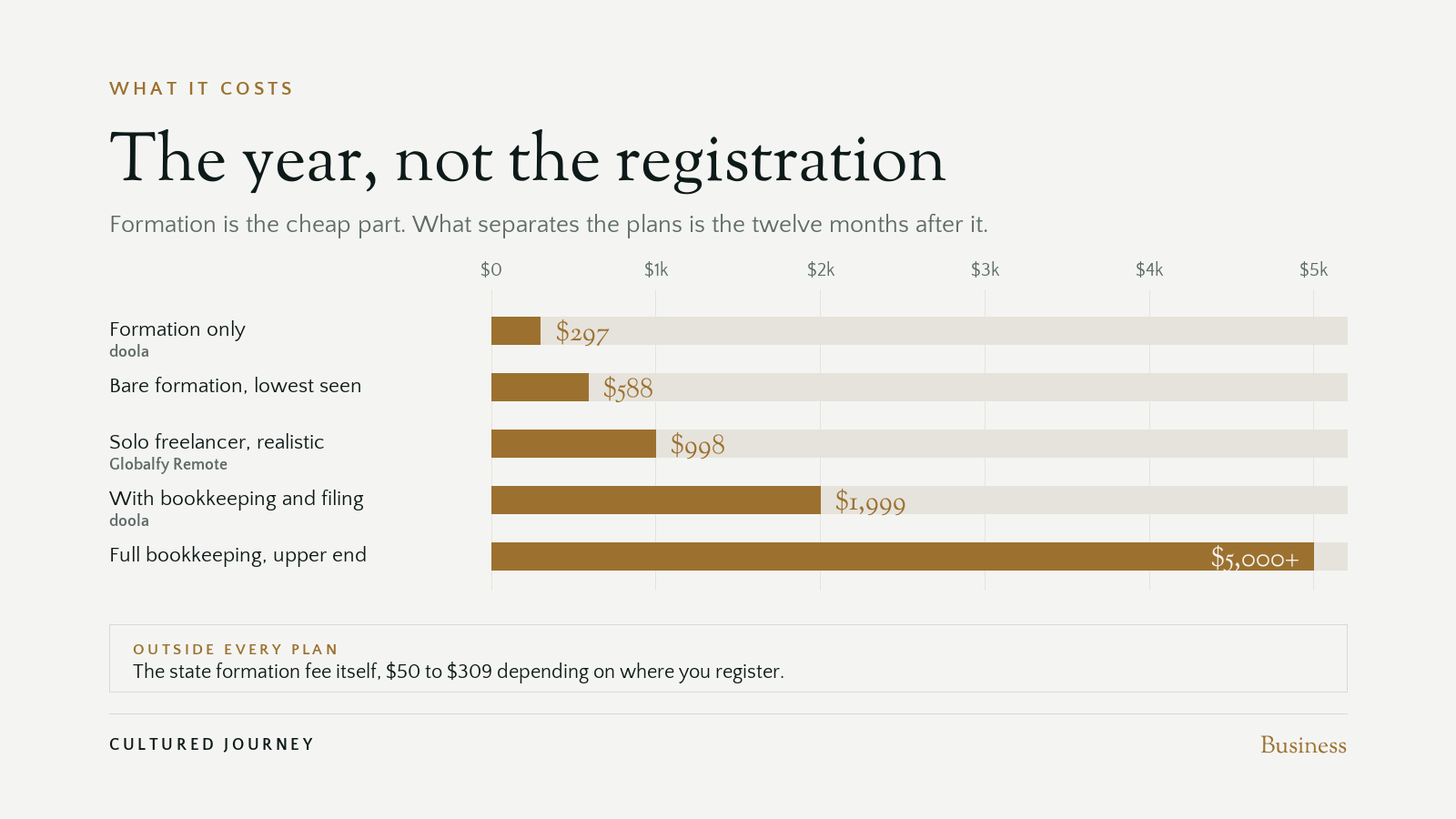
- Investment range: annual plans from $588 for simple formation to more than $5,000 a year for companies with full bookkeeping. For a solo freelancer, the recommended plan is usually around $1,000 a year.
Do I need a U.S. company as a freelancer?
The short answer: it depends on who pays you and how much of your business that revenue represents.
If you are a freelancer based outside the U.S. with an occasional American client, a dollar account and a good contract may be enough for now. But if a large share of your revenue comes from the U.S. via Upwork, Stripe, a direct client or an American agency, not having an LLC becomes a recurring obstacle: contracts that ask for an EIN, platforms that hold payments to foreign individuals, or simply the feeling of billing as a sole contractor in a market that works with formally registered suppliers.
One point is worth clarifying, because a lot of content on this topic exaggerates here. Work performed entirely outside the United States, by a professional who is also outside the United States, is generally treated as foreign-source income for U.S. tax purposes. In practice, that means the IRS’s automatic 30 per cent withholding on payments to foreigners usually does not apply to a freelancer working from abroad for a U.S. client.
The real reason to form an LLC is almost never that withholding. It is the way clients, banks and payment platforms treat people without a formal U.S. structure. That is the problem Globalfy solves: it is not a tax consultancy, it is the structure, meaning EIN, address, bank account and deadline tracking, that makes U.S. clients stop treating you as an exception in their procurement process.
Why U.S. clients and platforms ask you for one
U.S. companies are used to hiring suppliers who fill in a Form W-9, for U.S. individuals and companies, or who operate with an EIN. A foreign freelancer with no formal entity falls into a grey area: the client has to deal with W-8BEN forms, understand that the payment does not generate a 1099 and, often, would rather just hire someone who has already sorted that out.
This shows up strongly in three situations, according to Globalfy’s history serving Latin American clients:
- Pressure from payment gateways. Stripe and PayPal have been restricting accounts held by individuals in countries outside the U.S., asking for a U.S. entity’s details to release larger payouts.
- Corporate onboarding. Mid-size and large U.S. companies have procurement processes that ask for a U.S. tax ID, a business address and, sometimes, a local bank account before approving a supplier.
- Perception of credibility. Billing as “YourName LLC” instead of under a personal name changes how the client approaches the negotiation, especially in higher-value recurring contracts.
None of these three reasons is about tax. All of them are about operational friction, and that is exactly the kind of friction a well-built structure removes. Among the clients operating through a U.S. entity with Globalfy is Igor Turano of TURALABS LLC, in Chile, one of the named testimonials on Globalfy’s site.
When forming an LLC to provide services to the U.S. makes sense
There is a tipping point where it is worth it. It usually shows up when at least two of these conditions are true:
- More than 30 per cent of your annual revenue comes from U.S. clients or platforms.
- You have already had a payment delayed, held or refused for lack of U.S. documentation.
- A client has formally asked for an EIN, a W-9 or a U.S. bank account to sign or renew a contract.
- You plan to work with multiple U.S. clients over the next 12 months, not on a one-off project.
If none of these conditions applies yet, waiting is a reasonable decision. Forming a company to provide services to the U.S. has an annual cost, and it makes no sense to pay for a structure your current operation does not need. If two or more apply, the maths changes: the cost of not having the company, in lost business, time spent explaining your tax situation and delayed payments, tends to exceed the price of an annual plan.
What an LLC solves in practice for those billing in dollars
Thinking specifically about a freelancer LLC for someone based abroad, the concrete gains are usually these:
- An EIN and a U.S. bank account. This addresses the most common request from corporate clients and unlocks accounts on platforms such as Stripe and Mercury, even without an SSN.
- A U.S. business address with mail scanning. Useful for platform sign-ups, opening accounts and, in some cases, contractual requirements.
- Billing under your own business identity. Invoicing in the company’s name, not as an individual, changes how corporate clients assess a supplier, especially on mid-size contracts.
- Compliance built in. An LLC has annual obligations in the U.S., including the Annual Report and federal forms such as the 5472 combined with the pro-forma 1120 for single-member LLCs. Ignoring those deadlines leads to penalties: the penalty for not filing Form 5472 correctly starts at $25,000 per form under IRS rules. A provider that tracks the deadline calendar keeps that risk from becoming reality.
Step by step to form your company
The process, end to end, follows four stages:
- Choose the state and entity type. Most freelancers choose an LLC rather than a C-Corp, and Wyoming is the most popular state for this profile. Most service providers choose it for its low maintenance cost and the absence of a state income tax.
- State registration and EIN. Registration in Wyoming usually takes 1 to 7 business days; the EIN comes through 2 to 3 days after that, with no SSN required. No U.S. visa is needed, a passport is enough.
- Address, registered agent and bank account. The business address and registered agent are legal requirements of the state; the bank account is usually opened with partners such as Mercury or Lili, which accept applications even before the EIN is issued.
- Ongoing compliance. From here on, the annual obligations calendar, federal filings and, where relevant, an accountant who specialises in non-residents come into play.
How much it costs to maintain a U.S. company as a freelancer
For a solo consultant or freelancer, with no partners and no physical presence in the U.S., Globalfy’s Remote plan at $998 a year is usually the right starting point. It includes formation, EIN, business address, registered agent, compliance calendar, a dedicated account executive, help opening a bank account, the annual state renewal and the basic federal filings, meaning Form 5472 and the pro-forma 1120.
It is worth comparing against standalone fees, not just against a competitor’s formation price. A formation-only plan may cost less at first, but it usually does not include the registered agent in later years, deadline reminders or federal filings, items that, charged separately, bring the total close to what already comes with a plan like Remote.
On top of that, the partner perks package exceeds $200,000 in credits, and combining just two or three of them already covers a good part of the annual fee: up to $500 in reduced Stripe fees, $1,000 in OpenAI API credits and a free Fynance licence for bookkeeping, worth $300. Added together, those three benefits alone already exceed the cost of the Remote plan.
Costs that sit outside any plan and are worth considering: the state formation fee, from $50 to $309 depending on the state, and the annual renewal fee charged by the state itself, for example $62.25 in Wyoming.
Globalfy or other alternatives?
For those researching an LLC for freelancers with U.S. clients, three names often come up in comparisons: Stripe Atlas, doola and Globalfy itself.
| Criterion | Globalfy | Stripe Atlas | doola |
|---|---|---|---|
| Best for | Freelancers and consultants who want formation plus ongoing compliance in one place | Those who only need to form fast and already have their own accountant | Freelancers comfortable with a fully self-service product in English |
| Human support in your language | Yes, dedicated specialists in EN, PT and ES | Self-serve, in English | Mostly English |
| Annual compliance included | Yes, on the Remote plan | No, formation only | Only on the Tax and Compliance plan, $1,999/year |
| Reference price | From $998/year (Remote) | Low formation cost, but no ongoing maintenance | $297/year (formation only) or $1,999/year (with bookkeeping and tax filing) |
Stripe Atlas is strong for those who just want to form fast and already handle the tax side with a separately hired accountant. It is a formation, not an ongoing operation. doola charges $297 a year on its entry plan, but that does not include tax filing or bookkeeping; to reach a scope similar to Globalfy’s Remote plan, the comparable option is doola’s Tax and Compliance plan at $1,999 a year, still with support mostly in English.
Globalfy closes that gap with compliance included from $998 a year: more than ten years serving founders across Latin America and Europe, a 4.9 out of 5 Trustpilot rating from more than 700 reviews, and a model designed from the start for people who do not live in the U.S.
How to choose the right partner
Before deciding who to form with, ask these five questions:
- Does the plan cover the whole year, or just formation? Registering an LLC is easy; keeping it current for years is where most freelancers slip up.
- Is there support in your language, with a real person? Questions about double taxation between your country and the U.S., and about tax forms, are easier to resolve in your own language.
- Is help opening a bank account included, and can you start without an SSN? That changes how long it takes until you can receive your first payment.
- Are state and third-party fees explained before purchase? A transparent provider shares this proactively, with no fine print.
- What happens if you choose the wrong state or plan? Check whether you can switch later, with prorated billing and no penalty.
Get your case assessed by Globalfy
If your billing with U.S. clients is already more than occasional, it is worth talking to a specialist before losing more time on red tape alone. Globalfy has helped more than 10,000 founders in more than 100 countries form and maintain a U.S. company, with human support in English, Portuguese and Spanish from start to finish.
Talk to a Globalfy specialist and find out, in a single conversation, whether the Remote plan is the right option for you as a freelancer right now.
Frequently asked questions
Do I really need a U.S. company as a freelancer with U.S. clients?
It is not mandatory in most cases, but if a meaningful share of your revenue comes from U.S. clients or platforms, an LLC solves concrete problems: receiving payments via Stripe and Mercury, invoicing with a U.S. tax ID, and credibility in corporate contracts. It is usually worth it once more than 30 per cent of your annual revenue already comes from those clients.
How long does it take to form a U.S. LLC as a freelancer?
State registration in Wyoming, the state non-resident freelancers use most, takes 1 to 7 business days. The EIN comes through 2 to 3 days after that. From start to finish, most freelancers have the company registered and the U.S. tax ID in hand in less than two weeks.
Will I pay tax in the U.S. and in my country at the same time?
A non-resident single-member LLC is a pass-through structure: the company itself does not pay U.S. federal income tax on profit, and taxation happens at the member level, under each country’s rules and any applicable tax treaties. That does not remove the obligation to report in your country, but it avoids the automatic double charge many freelancers fear. An accountant who specialises in non-residents is essential to apply this correctly to your case.
What documents do I need to form a U.S. company as a foreign freelancer?
A valid passport is the only personal document required. You do not need a U.S. visa or an SSN to form the LLC. The EIN is applied for without a Social Security Number, by fax or mail, since the freelancer does not have one.
How is Globalfy different from forming on your own or using a formation-only service?
The core difference is what happens after formation. Doing it yourself, or using a service that only registers the company, leaves the registered agent, deadline calendar and federal filings to the freelancer in later years. Globalfy includes all of that in the annual plan, with a dedicated account executive and multilingual human support, the reason most often cited by clients who switch from other providers.
Can I receive payments from platforms such as Upwork and Stripe with my LLC?
Yes, that is one of the most common reasons to form the company. With an EIN and a U.S. bank account, such as those offered by Mercury and Lili, payment platforms process funds as payments to a U.S. entity, reducing the blocks that affect accounts held by foreign individuals.